

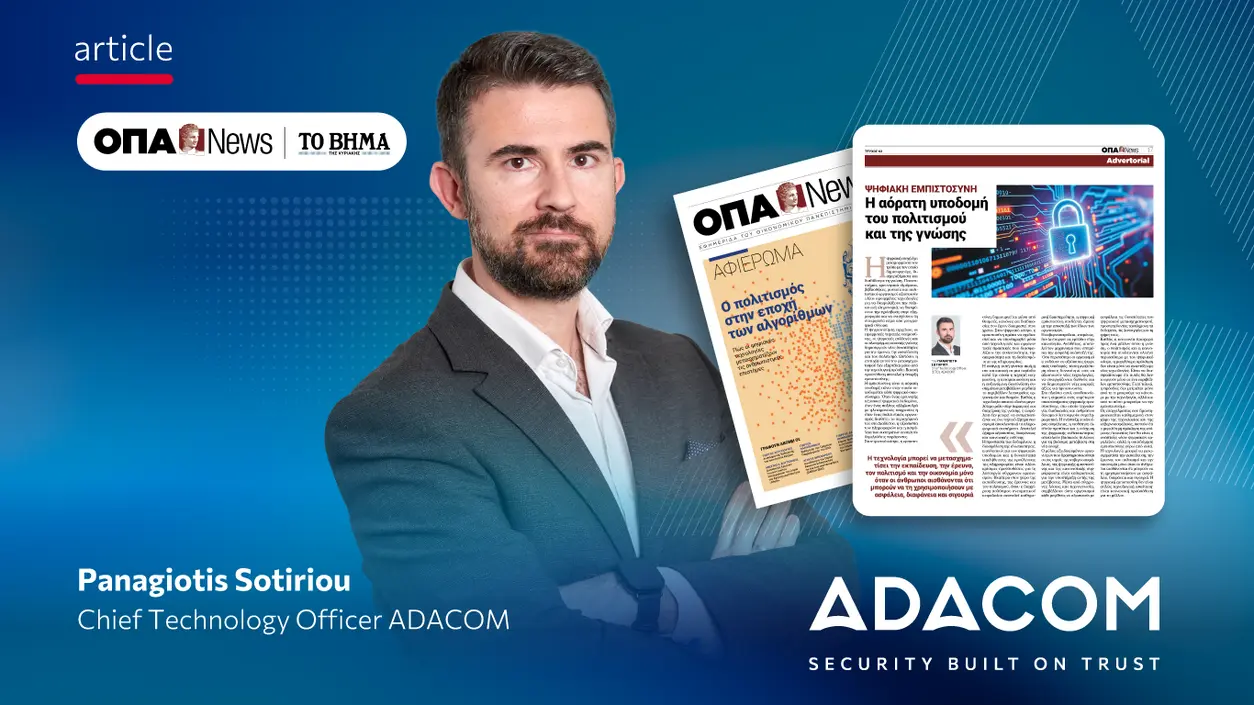
By Panagiotis Sotiriou, Chief Technology Officer of ADACOM, Published in OPA NEWS at To Vima Kyriakis
Digital Trust: The Invisible Infrastructure of Culture and Knowledge
The digital era has transformed the way we create, manage, and disseminate knowledge. Universities, research institutions, libraries, museums, and cultural organizations now leverage advanced technologies to preserve cultural heritage, expand access to information, and strengthen collaboration beyond geographical boundaries.
The digitization of archives, artificial intelligence applications, digital collections, and open knowledge platforms are creating new opportunities for research, education, and culture. However, the success of this transformation does not depend solely on technological progress. A fundamental prerequisite is the existence of trust.
Trust is the invisible infrastructure upon which every digital ecosystem is built. When a researcher utilizes digital data, when a citizen interacts with electronic services, or when a cultural organization makes its content available online, the reliability of information and the security of systems become fundamental factors. In the physical world, trust is established through institutions, rules, and processes that have stood the test of time. In the digital world, trust must be designed and supported through technological and organizational practices that ensure the authenticity, integrity, and availability of information.
This need becomes even more pressing at a time when artificial intelligence, automation, and the increasing interconnectedness of systems are rapidly transforming the operating environment of organizations and institutions. As technology assumes an ever-greater role in the production and management of knowledge, security can no longer be viewed as a purely technical issue concerning information systems alone. It is a matter of reliability, transparency, and social responsibility.
Data protection, the safeguarding of privacy, the resilience of digital infrastructures, and the ability to verify the provenance of information have become critical prerequisites for the operation of modern organizations. Particularly in the fields of education, research, and culture, where the management of valuable intellectual capital is a daily activity, digital trust is directly linked to the very mission of these organizations.
Cybersecurity, therefore, does not act as an obstacle to innovation. On the contrary, it is the mechanism that enables its secure development. The more organizations invest in reliable digital infrastructures, the greater their ability to leverage emerging technologies, collaborate internationally, and create new forms of value for society.
In this context, the importance of a broader digital trust ecosystem becomes evident—one in which technology, processes, and people operate in a complementary manner. Developing a culture of security, adopting international standards, and strengthening digital resilience constitute key pillars for a sustainable transition to the new era.
The role of specialized organizations operating in the fields of cybersecurity, digital trust, and regulatory compliance is crucial in supporting this transition. Through modern solutions and expertise, they enable organizations of every size to safely leverage the opportunities of digital transformation while protecting their data, operations, and reputation.
As society moves toward a future in which knowledge, culture, and innovation become increasingly connected to the digital world, the greatest challenge is not merely to develop new technologies. It is to ensure that they operate within an environment of trust. Ultimately, progress is measured not only by what we can do with technology, but also by how much we can trust it.
As a professional working daily in the fields of technology and cybersecurity, I believe that the greatest challenge of the coming decade will not be the development of new digital tools, but the building of trust around them. Technology can transform education, research, culture, and the economy only when people feel they can use it with security, transparency, and confidence. Digital trust is not merely a technological requirement; it is a social prerequisite for the future.
Read also the full article in greek here: ΤΕΥΧΟΣ 63ο - ΙΟΥΝΙΟΣ 2026 | Οικονομικό Πανεπιστήμιο Αθηνών