

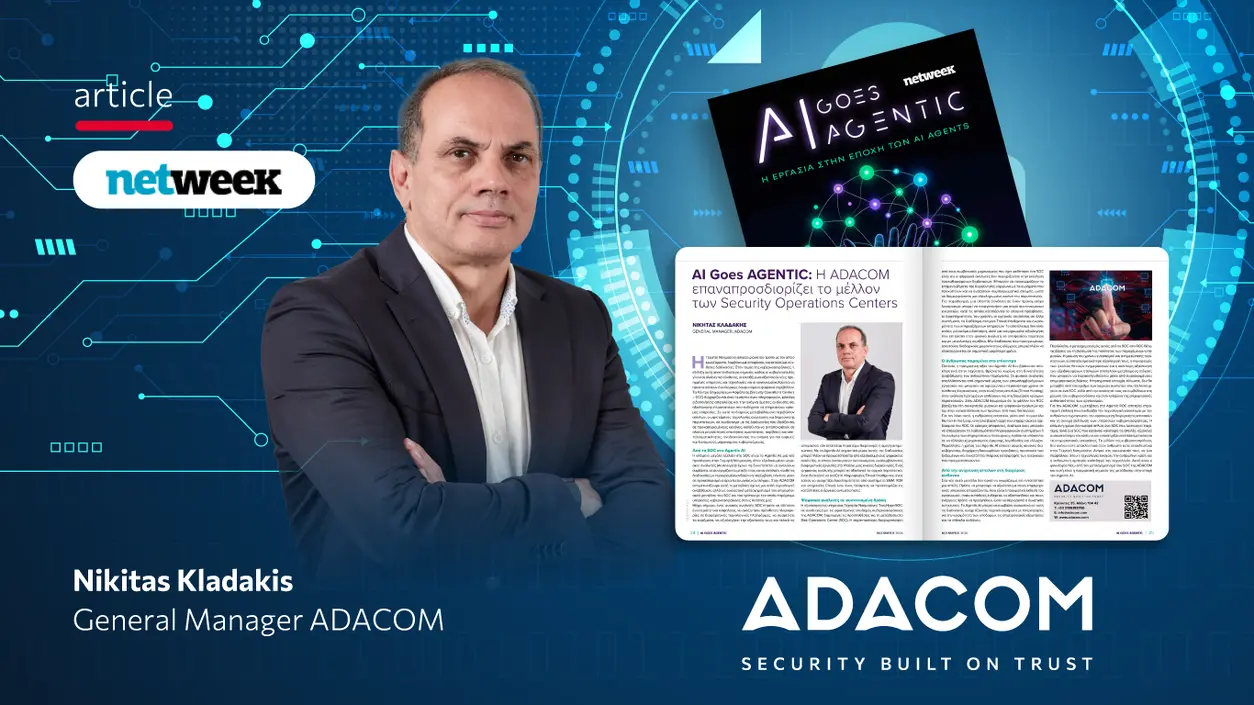
By Nikitas Kladakis, General Manager of ADACOM, Published in NetWeek at Vima Kyriakis
Artificial Intelligence is fundamentally changing the way we work, make decisions and execute complex processes. In the field of cybersecurity, this evolution is particularly significant, as cyber threats are becoming increasingly sophisticated, attackers are leveraging new advanced services and technologies, and organizations are being called upon to protect an ever-expanding digital environment.
Security Operations Centers (SOCs) handle enormous volumes of information, thousands of security alerts and the need for immediate analysis and assessment of incidents that may affect critical services. In this constantly evolving threat landscape, existing incident detection and investigation technologies, combined with rule-based processes, are facing increasingly demanding requirements for speed, accuracy and efficiency. This highlights the need for more intelligent and dynamic cyber defense mechanisms.
The next major evolution in the SOC is Agentic AI, a new approach to Artificial Intelligence in which specialized digital analysts (AI Analysts) can analyze events, collaborate with one another and execute complex processes with limited human intervention, always within predefined operational and control boundaries. At ADACOM, we view this transition not as a simple technological upgrade, but as a fundamental transformation of the SOC's operational model and the way we deliver cybersecurity services to our customers.
Until now, a human SOC analyst had to investigate a security incident, search for additional information across different technology platforms, correlate findings, assess their reliability and ultimately decide whether further investigation or immediate response was required. With Agentic AI, a significant part of this process can now be carried out by specialized digital analysts working in coordination and taking on different tasks as part of a unified investigation.
One AI analyst may assess the initial incident, a second may search for Threat Intelligence information, a third may correlate activities across SIEM, XDR and Cloud systems, while a fourth may prepare the appropriate response actions.
The use of the Torq HyperSOC artificial intelligence service, combined with ADACOM's existing cybersecurity infrastructure, creates the conditions for the transition to a Risk Operation Center (ROC). The most significant difference compared to the conventional mechanisms adopted by a SOC is that AI analysts are not limited to executing predefined procedures. They can adapt the next steps of an investigation based on emerging findings, search for supplementary evidence and build a comprehensive picture of the incident.
For example, a suspicious login to a privileged account may trigger a series of coordinated actions, examining access history, user activities, related connections to other systems, available Threat Intelligence information and the criticality of the affected services. The result is not simply another alert, but a well-documented assessment that enables the human analyst to make decisions more quickly and accurately. A process that previously required successive manual checks can now be completed in significantly less time.
However, the real value of Agentic AI lies not exclusively in speed. It lies primarily in its ability to enhance the human factor. Human analysts are relieved of a significant proportion of repetitive tasks and can devote more time to complex investigations, Threat Hunting, advanced attack analysis and the management of critical incidents. At ADACOM, we believe that the future of the ROC is built on collaboration between human and digital analysts, rather than replacing the former with the latter.
For this reason, human oversight through the Human-in-the-Loop model is a fundamental principle of the ROC's operational design. Critical decisions, particularly those that may affect the availability of information systems or the continuity of business operations, must be subject to appropriate approval, accountability and control mechanisms. At the same time, the use of Agentic AI requires clear governance rules, access rights management, data protection and the ability to fully record all actions performed.
In this new model, it is no longer enough to know that a threat has been detected. We must be able to assess which business services are affected, the organization's actual exposure, which vulnerabilities may be exploited and which actions should be prioritized to limit the potential impact. Agentic AI can make a significant contribution to this process by correlating technical findings with information about infrastructure criticality, business dependencies and risk levels.
At the same time, this transformation from SOC to ROC lays the foundations for improving the quality of services delivered. Reduced incident detection and response times, more effective incident assessment, fewer false-positive alerts and better utilization of specialized personnel are measurable objectives that can be monitored through specific operational indicators.
Ultimately, success will not be measured by the number of AI analysts operating within a SOC, but by their ability to contribute to reducing cyber risk and strengthening the operational resilience of organizations.
For ADACOM, the transition to an Agentic ROC is a strategic choice that combines technological innovation with human expertise, structured incident management and the continuous improvement of cybersecurity services.
The next day is not simply about a SOC that operates faster, but about a SOC that better understands threats, assesses risk more meaningfully and more effectively supports business decisions.
The future of cybersecurity belongs neither exclusively to humans nor exclusively to Artificial Intelligence. It belongs to their collaboration, in an environment where technology enhances human judgment and human experience guides technology.
This is the philosophy behind the transformation of ADACOM's SOC, and this is the true significance of the transition to the era of Agentic AI.
You can read the article in Greek here: Netweek