

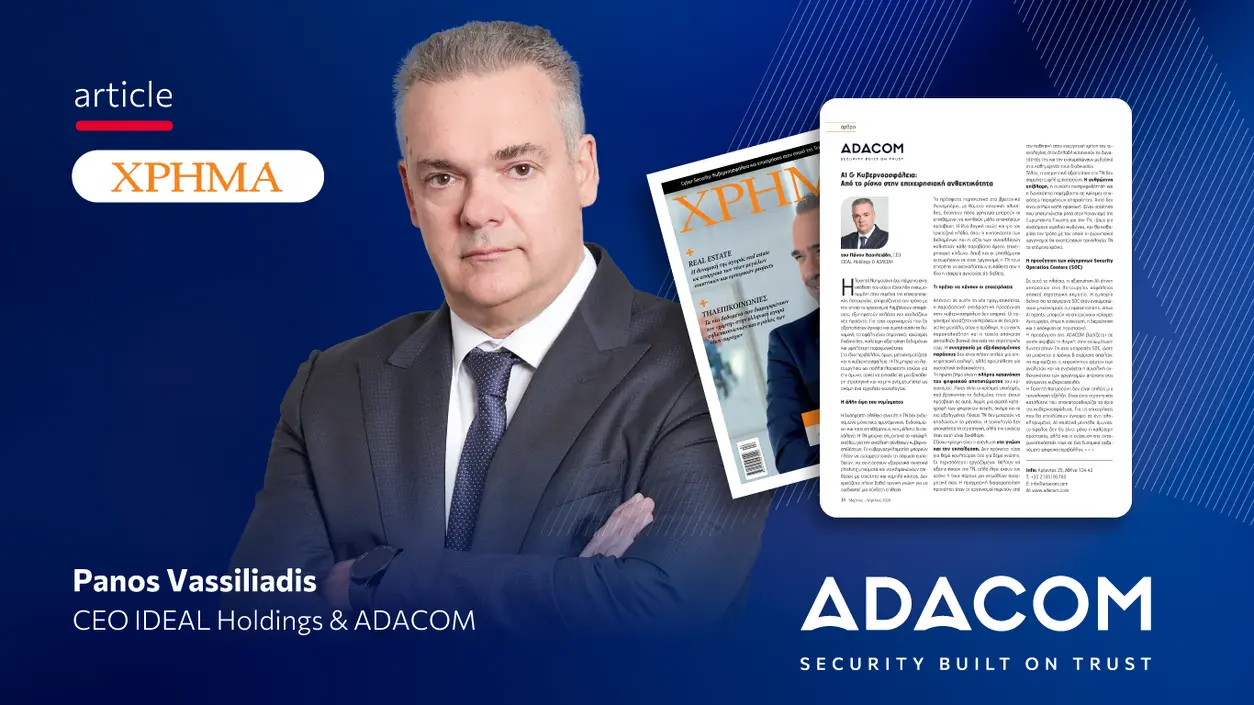
By Panos Vassiliadis, CEO of IDEAL Holdings & ADACOM
Artificial Intelligence is no longer a matter of the future. It is already embedded at the core of business operations, influencing the way organizations make decisions, serve customers, and design new products. For organizations that leverage this dynamic early and effectively, the benefits are significant: faster processes, better use of data, and higher productivity.
At the same time, however, cybersecurity itself is being transformed. AI can act as a force multiplier for defense, provided it is integrated into a clear strategy and not treated as just another technology tool.
The Other Side of the Coin
The uncomfortable truth is that AI does not only empower defenders. It also empowers attackers — and disproportionately so. AI significantly lowers the barrier to entry for executing sophisticated cyberattacks. Cybercriminals can now automate vulnerability scanning, craft highly convincing phishing messages, and scale attacks with speed and low cost. Deep technical expertise is no longer required to design a complex attack.
Recent incidents in the UK retail sector, involving historic retail chains, demonstrate how quickly attackers can move once access is gained. The same logic applies to the banking sector, where the movement of data and the value of transactions make every breach an immediate operational risk. Once attackers infiltrate an organization, AI enables them to uncover vulnerabilities the company itself may not have been aware of.
What Businesses Need to Do
Against this new reality, the traditional reactive approach to cybersecurity is no longer sufficient. Organizations must transition to a proactive model, where prevention, continuous monitoring, and rapid response become core elements of their strategy. Collaboration with specialized providers is no longer simply a business option, but a prerequisite for meaningful resilience.
The first step is a complete understanding of the organization’s digital footprint. Which infrastructures are critical? Where is data stored? Who has access to it? Without a proper inventory of digital assets, even the most advanced AI solutions cannot deliver maximum value. Technology does not replace strategy; it strengthens it when that strategy is clear.
Equally critical is investment in knowledge and education. This is not merely a matter of culture, but of capability. Most employees want to leverage AI, yet few have the time or resources to truly understand how to use it effectively. Real differentiation emerges when organizations move from passive to active use of technology — when they understand its capabilities and methodically integrate them into everyday operations.
Finally, actively leveraging AI does not mean blindly trusting it. Human oversight, continuous feedback, and the ability to intervene in critical decisions remain essential. This is not simply best practice; it is a requirement explicitly reflected in the European Union’s AI Act, particularly for high-risk systems, and it will shape how European organizations develop AI technologies in the years ahead.
The Role of Modern Security Operation Centers (SOC)
Within this framework, the use of AI-driven services in security operations becomes strategically important. Experience shows that modern SOCs, when integrating automation mechanisms such as AI agents, can accelerate critical functions including threat detection, investigation, and incident response.
ADACOM’s approach is built precisely on this logic: integrating AI capabilities into SOC services in order to reduce threat response times, minimize analysts’ manual workload, and strengthen organizations’ overall resilience against modern cyber threats.
Artificial Intelligence is not simply another technological evolution. It is a strategic catalyst that is redefining the boundaries of cybersecurity. For organizations that invest early in a comprehensive, AI-enabled defense model, the benefit will not only be stronger protection, but also enhanced competitiveness in an increasingly dynamic digital environment.
Originally published in «Χρήμα» magazine.
📖 Read the publication here in greek: ΧΡΗΜΑ - Τεύχος 481 | Ethosmedia.eu